Write a Competitive, Evaluator-Aligned Horizon Europe Proposal
8-week guided group programme
Start: Thursday, 26 November 2026
Securing Horizon Europe funding can open the door to ambitious research and innovation projects, international collaboration and significant project budgets.
But competition is high. A strong idea and a capable consortium are important starting points, yet they are not enough on their own. Your proposal also needs to translate the project into a clear, coherent and evaluator-aligned case for funding.
Evaluators need to understand quickly what you want to achieve, why your approach is credible, how the project responds to the Call and why your consortium is well placed to deliver it.
A strong Horizon Europe proposal needs to show:
This programme is not about simply filling in the templates. It helps you understand the architecture behind a competitive proposal and apply this logic step by step to your own proposal work.
The programme includes eight core live sessions delivered across eight programme weeks, with a planned break over Christmas. You also receive a community platform for ongoing questions, two private 1:1 calls, practical resources and additional bonus content to help you apply the programme to your own proposal.
Depending on where you are in your proposal process, by the end of the programme you will either have developed a structured and compelling first draft of your Horizon Europe Part B, or have the knowledge, tools and roadmap to develop one in the months ahead.
This programme is for researchers, innovators and professionals from:
… who are actively preparing, or planning to prepare, a proposal in 2027 under one of Horizon Europe’s Pillar 2 thematic Clusters.
You may be:
If you are serious about submitting a competitive proposal and would value structured guidance within a supportive group setting, this programme is for you.
Please note: The programme is designed for Horizon Europe applicants and organisations developing their own proposals. If you work professionally in proposal development for clients, proposal-writing training or proposal automation, please get in touch before enrolling.
We will be covering all the important questions such as:
Over the course of 8 weeks, you will develop:
✔ a structured draft of your Part B content
✔ a clearer understanding of how to align your proposal with the evaluation criteria
✔ a credible impact logic
✔ defined consortium roles and governance structures
✔ a realistic and justified budget
✔ a structured final quality control process
You move from:
“We are trying to understand what each template section expects.”
to:
“We have a clear framework for shaping each section and keeping the proposal clear and coherent.”
The aim is to help you become the architect of your proposal, with a clear understanding of how the different sections fit together and reinforce the overall proposal logic.
This group programme is a guided implementation programme with expert support and structured peer exchange.
You receive:
Participants come from different disciplines, institutions and proposal contexts. Through the live sessions and the community space, you benefit from seeing how others approach similar questions from different angles.
Very often, someone else raises the exact question you had not yet thought to ask – but which is also relevant for your own proposal. This helps you anticipate issues earlier, strengthen your structure and make more informed decisions as your draft develops.
You decide what you wish to share in the group setting. Sensitive or proposal-specific details can always be addressed in your private 1:1 sessions.
Hello, I’m Astrid Mechel,
I help organisations secure EU funding through tailored advice and practical trainings. With more than 20 years of experience in EU funding programmes and policies, I bring deep, hands-on expertise from multiple perspectives. I’ve written successful EU grant applications myself, advised applicants as a National Contact Point for Horizon 2020 and Horizon Europe, and worked in an EU Executive Agency – including as moderator of expert evaluator consensus meetings.
Today, alongside my core advisory and training work, I also occasionally serve as an expert evaluator. This gives me a clear and up-to-date understanding of how proposals are assessed in practice.
Specialising in Horizon Europe grants for research and innovation, environmental sustainability, and social impact, I help organisations navigate the complexities of EU funding and maximise their proposal’s chances of success.
Having worked on different sides of the process – as applicant, advisor and evaluator – I have designed this programme to reflect how proposals are actually read, assessed and scored.

“Thank you for the highly insightful workshop. I greatly appreciated your strategic guidance and clear explanations. Your support in refining our proposal and targeting the right Call made a tangible difference. The interaction was engaging, and your expertise was evident throughout.”
Circular Economy Project Manager
Belgium
“Working step by step through the application process was extremely valuable. The clear explanations, practical examples and opportunity to ask questions made the complexity much easier to understand. I now feel better prepared to apply this approach in my own proposal work.”
Research Project Manager
Spain
“Astrid’s seminars were highly professional and delivered at an excellent technical level. She explains complex aspects of EU funding in a clear and practical way. After the course, I felt significantly more confident in structuring proposals and building realistic budgets.”
Social Scientist
Germany
Across eight core programme weeks, you move through the key building blocks of a competitive Horizon Europe proposal: from Call interpretation and proposal architecture through Excellence, Impact, Implementation, Budget and final submission readiness.
The programme is structured around one clear focus per week, so you can develop the proposal step by step. Throughout the programme, we strengthen strategy, coherence and evaluator alignment, with attention to the areas where proposals often lose points.
Each session combines expert input with dedicated time for participant questions and practical discussion.
Before detailed drafting begins, you build the strategic foundation of your proposal. We start by interpreting the Call topic, clarifying the core project logic, defining the coordinator’s role and mapping how the consortium should support the proposal.
This helps you understand what the Call is really asking for, how the proposal needs to be structured and how partners should contribute to a coherent and credible project design.
This week focuses on the Excellence section: clear objectives, ambition, progress beyond the state of the art and methodological robustness.
The aim is to make the project rationale clear: what the project will achieve, why the approach is credible and how the methodology supports the expected results.
Many Horizon Europe proposals lose strength when the Impact section stays too broad or generic. In this week, we make the connection between your project results and the Call’s expected impacts more precise.
We work on impact pathways, stakeholder engagement and beneficiary logic, so you can show who benefits from the project, how results can lead to measurable outcomes and why your proposed impact pathway is credible.
In this second Impact week, we focus on dissemination, exploitation, sustainability and intellectual property strategy.
You will clarify how project results will be shared, used and taken forward after the funded period ends.
By the end of this week, you will be able to explain how key results will reach the right audiences, how uptake can happen in practice, what role partners play in exploitation, and how sustainability and long-term value beyond the project lifetime can be demonstrated.
Here, we translate the project logic into a practical and credible implementation structure.
We look at how to design work packages, define tasks, deliverables, milestones, risks, governance and quality assurance so that the work plan clearly supports the objectives, methodology and expected impact.
A key focus is whether partner roles are specific, justified and aligned with the tasks they are expected to deliver. This helps show that the project is not only ambitious, but also feasible, well managed and internally consistent.
Includes a recorded tutorial on AI-supported Gantt and PERT chart development.
In Week 6, we connect the budget back to the work plan and partner roles.
We review eligible cost categories, person-month calculations, cost allocation across partners, budget justification and common budgeting pitfalls, including considerations for lump-sum proposals where relevant.
The aim is to help you build a budget that is realistic, credible and aligned with the actual tasks, responsibilities and level of involvement of each partner, so that the resources clearly support the proposal logic.
This week helps you step back from the proposal and assess whether it still works as one coherent project story before submission.
The session focuses on the main connections across the proposal: objectives, methodology, expected results, impact pathway, work plan, partner roles, risks and budget logic.
You will learn how to spot weak links, missing connections and inconsistencies that can make a proposal fragmented, even when the individual sections seem well developed.
We also look at the most important submission-readiness checks that should not be left until the last moment, including consistency between Part A and Part B.
In the final session, we bring the different elements of the proposal together and focus on the questions that have emerged as you have worked through the programme.
We revisit any remaining strategic or drafting issues across Excellence, Impact and Implementation, clarify proposal-specific questions and identify the priorities that still need attention.
You will leave the programme with a clear action plan for completing, refining and quality-checking your Part B in the weeks ahead.
In the Horizon Europe Proposal Writing Mastery Programme, the goal is not to overwhelm you with more information. Instead, the programme will give you a clear writing sequence, practical decision points, practical supporting materials, checklists and expert guidance so your proposal becomes more coherent, more credible and easier for evaluators to follow.
In addition to the core programme and its included support materials, you receive:
Join by 3 July 2026 (12:00 CEST), and receive a personalised Proposal Readiness Snapshot before the programme starts. After enrolment, you will be invited to complete a short questionnaire about your Call topic, project idea, consortium status and current proposal challenges. Based on your answers, I will prepare initial recommendations to help you enter the programme with more strategic direction for your proposal development.
The investment for participating in this programme is 1,800€ (excl. VAT). A payment plan in two instalments is available.
If you have previously participated in one of my Horizon Europe Proposal Writing Workshops, you are eligible for a special participant voucher (value: €170). Please contact me to receive your voucher code.
The full guided programme includes all eight core live sessions, two private 1:1 calls, community support, templates, checklists, programme materials, recordings and bonus content.
You will retain access to the programme materials and session recordings for at least 12 months after the programme ends.
Preparing a strong Horizon Europe proposal requires more than writing time. You need to interpret the Call correctly, make strategic decisions early, align the different proposal sections and leave enough time for review and refinement.
This programme gives you a structured process for doing that, with expert guidance, practical tools and a group environment in which you can learn from questions and challenges arising across different proposal contexts.
If you intend to submit a Horizon Europe Pillar 2 proposal in 2027, the programme will help you approach the process with a clearer structure, stronger internal alignment and a realistic plan for moving from your project idea to a competitive proposal.
The programme starts on 26 November 2026.
To ensure high-quality interaction and meaningful individual support, the group size for this first cohort is limited to a maximum of 10 participants.
To keep the group focused, relevant and mutually supportive, this programme is intended for people working within applicant organisations that are preparing their own Horizon Europe Pillar 2 proposal. It is not designed for service providers supporting client proposals.
The eight core live sessions take place from 12:30–14:00 CET (Brussels time) on:
All sessions will be recorded.
The date and time of the bonus session on AI in proposal writing will be announced separately.
The programme includes two private 30-minute 1:1 calls.
You can use these sessions to discuss questions specific to your own proposal, explore issues that you prefer not to discuss in the group, or clarify strategic points that emerge as your proposal develops.
The calls can be scheduled during the programme, except during the Christmas break.
The programme pauses over Christmas from 21 December 2026 to 3 January 2027.
During this period, no live sessions or private 1:1 calls will take place. You will, however, continue to have access to the recordings, programme materials and community platform.
I will check the community periodically during the Christmas break, but the usual 24-hour response time will not apply and replies may take a few days.
Normal community support and 1:1 sessions resume on 4 January 2027.
You will have access to the programme materials, templates, checklists and session recordings for at least 12 months after the programme ends.
This means you can revisit the sessions and resources as your proposal develops and return to relevant parts when you reach the corresponding stage of the writing process.
Yes. A VAT invoice can be issued for your organisation after registration. Please make sure to provide the correct billing details, including the organisation name, address and VAT number where applicable.
Yes. A certificate of attendance can be provided upon request after completion of the programme. To receive the certificate, participants should attend at least 7 of the 8 core programme’s live sessions.
Any more questions?
If you would like to clarify whether this programme is the right fit for you, feel free to send me a message via info[at]eufundingconsulting.eu, or book a short call via my calendar.
Any questions? Send a message to info[at ]eufundingconsulting.eu and I’ll get back to you asap!
PS: More thematic workshops are in preparation! If you would like to be informed when they are open, subscribe to the EU Funding News & Tips newsletter.
Online Workshop on 6 November!
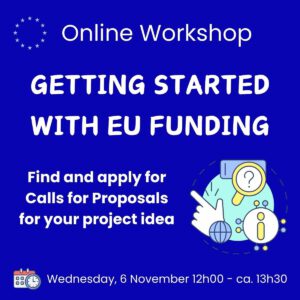
The workshop “Getting Started with EU Funding” is for participants with no or very limited experience in EU funding. Discover what kind of projects the EU is funding, the requirements and how you can apply for funding in your thematic field.
EU Funding Checklist

Do you have a new project idea and are wondering if EU funding could be available for your project?
This checklist will guide you through the most important questions to be considered when applying for EU project grants and includes some further suggestions how you could adapt your concept to be more in line with EU expectations regarding fundability.
Online Workshop
Interactive and step-by-step EU Proposal Writing Workshop
On 6 February 2025 from 13h00-16h30